
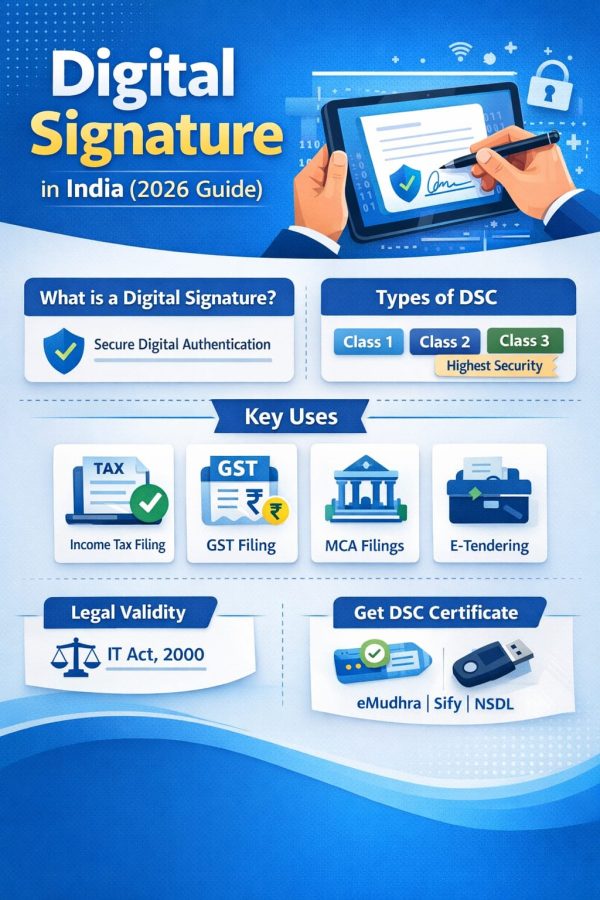
Introduction
In today’s digital world, paperwork is rapidly being replaced by electronic processes. One of the most important tools enabling this transformation is the Digital Signature. Whether you are filing GST returns, income tax returns, or signing documents online, digital signatures have become essential.
This article explains everything about digital signatures in a simple and practical way.
What is a Digital Signature?
A Digital Signature is an electronic form of a signature that is used to authenticate the identity of the sender and ensure that the document has not been altered.
It is based on cryptographic technology and is legally valid in India under the Information Technology Act, 2000.
How Does a Digital Signature Work?
Digital signatures work using Public Key Infrastructure (PKI):
A Private Key is used to sign the document
A Public Key is used to verify the signature
This ensures:
- Authenticity (who signed it)
- Integrity (document not changed)
- Non-repudiation (cannot deny signing)
Types of Digital Signature Certificates (DSC) in India
1. Class 1 DSC
- Basic level security
- Used for email verification
- Now mostly discontinued
2. Class 2 DSC (Merged)
- Earlier used for MCA & Income Tax
- Now merged into Class 3
3. Class 3 DSC (Most Important)
Highest level of security
Used for:
- Income Tax Filing
- GST Filing
- MCA Filings Tender submissions
Uses of Digital Signature
1. Income Tax Filing
Digital signatures are mandatory for companies and professionals while filing returns on
Income Tax Department of India portal.
2. GST Returns
Businesses use DSC for filing returns on
GST Network (GSTN).
3. Company Registration (MCA)
Required for filing forms on
Ministry of Corporate Affairs.
4. E-Tendering
Government tenders require Class 3 DSC for secure bidding.
5. Signing Contracts
Used for:
Agreements
Legal documents Online approvals
Benefits of Digital Signature
✔ Saves time (no physical signing)
✔ High security (encrypted)
✔ Legally valid
✔ Reduces paperwork
✔ Easy to use
Legal Validity in India
Digital signatures are fully valid under the Information Technology Act, 2000.
This means:
Digital documents are legally enforceable
Courts accept digitally signed documents
How to Get a Digital Signature Certificate (DSC)
You can obtain DSC from government-approved certifying authorities like:
eMudhra Limited
Sify Technologies
Steps to apply for digital signatures:
- Fill application form
- Submit ID & address proof
- Complete video verification
- Receive DSC on USB token
- Cost of Digital Signature in India (2026)
- Class 3 DSC: ₹1,500 – ₹2,500 (approx.)
- USB Token: ₹500 – ₹1,000
Conclusion
Digital signatures are a must-have tool for businesses, professionals, and taxpayers in India. They ensure secure, fast, and legally valid transactions in a digital environment.
As India moves toward complete digitalization, having a Digital Signature Certificate is no longer optional—it’s essential.